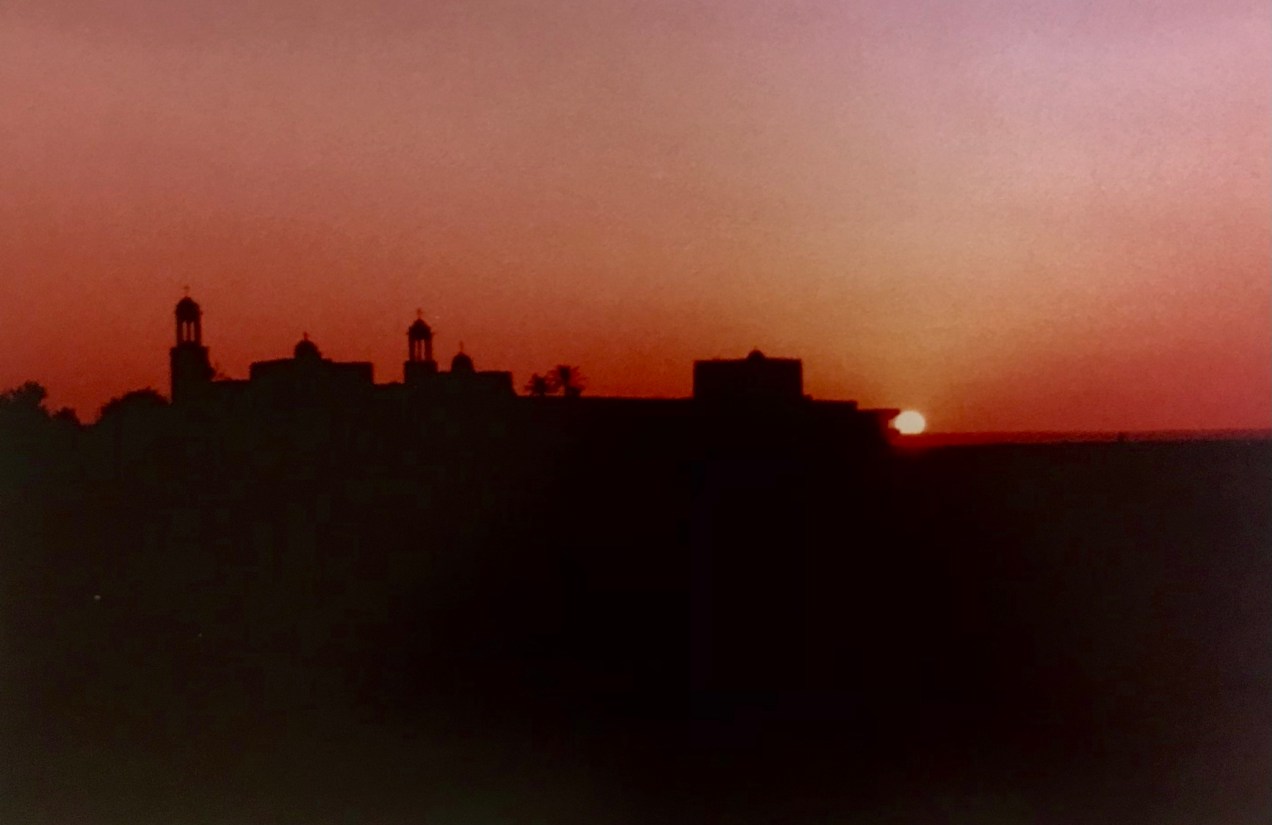
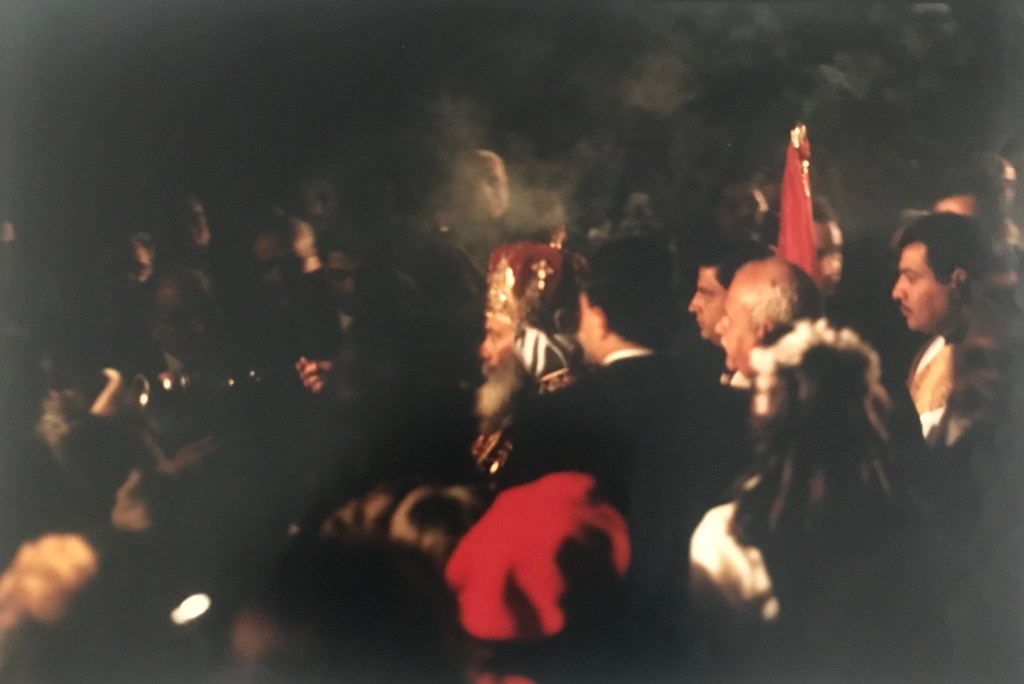
I thought it appropriate to publish a few of Monica’s photographs taken while we lived and studied in Egypt in the 1980s, as well as saying a few words about her and her work. I chose a handful of my favourite images from her large archives, all originally taken on 35mm and professionally hand printed, but unfortunately digitalised on a phone camera for expedience.
Born in the idyllic coffee growing highlands of the Jamaican Blue Mountains, Monica came to England to join her mum in Oxford at the beginning of the 1960s. She went to school and spent all her teenage years there and always spoke of her special love for its quaint cobbled streets, ancient colleges and beautiful Oxfordshire country side.
Monica was born with sickle-cell anaemia, a genetic mutation which means the red blood cells are not able to properly carry oxygen around the body, breaking down into sickle shapes and blocking tiny blood vessels, thus provoking what is called a “sickle crisis” which requires a medical emergency. She had her first crisis at the age of 4, but was only accurately diagnosed with full sickle-cell disease in her 20s. Over the years, sickle-cell eventually brings on organ deterioration because (but not only) of a chronically low haemoglobin count. Once at the age of 25, she was told by a doctor that she wouldn’t reach 30. Later, at the age of 50 she was told by an eminent haematologist in California that she should take her last long-haul flight to find a place to die because she needed a lung and heart transplant. But, by the grace of God, Monica confounded them all by living out her full three score years and ten according to psalm 90:10 and was able to achieve more than most.
She was a true warrior, even in times of great suffering and physical weakness. Yet she did not let her disability define who she was or stop her from achieving her goals, breaking all the moulds and stereotypes at every opportunity. By her early 20s she had travelled extensively internationally, worked in high fashion and later as a fashion/beauty journalist, including a stint in the prestigious London Vogue’s fashion room in 1980. We married in 1977 and both converted to Orthodoxy 3 years later. Finding fashion quite shallow, she decided to return to university and eventually started a project at SOAS in the early 90s researching Coptic art.
We spent most of the 1980s living/studying in Egypt under the supervision of Prof Isaac Fanous. Always fascinated by cultural and art history, Coptic Egypt and particularly Coptic art, became the focus of her research for many years. She wrote when she could, usually between periods of illness or stays in hospital. Her published work remains the primary source of reference regarding the life and work of Prof. Isaac Fanous, and the Contemporary School of Coptic Iconography.
Monica’s light has not gone out but has only become stronger and brighter in our hearts. Her golden and generous heart and happy spirit will always be sorely missed. Her constant and ever increasing suffering, especially in the last 5-6 years has finally come to an end and she is now free of pain in the bosom of her Lord and Saviour Jesus-Christ.
It was a true privilege and a great blessing for me to be her husband for 45 short years.
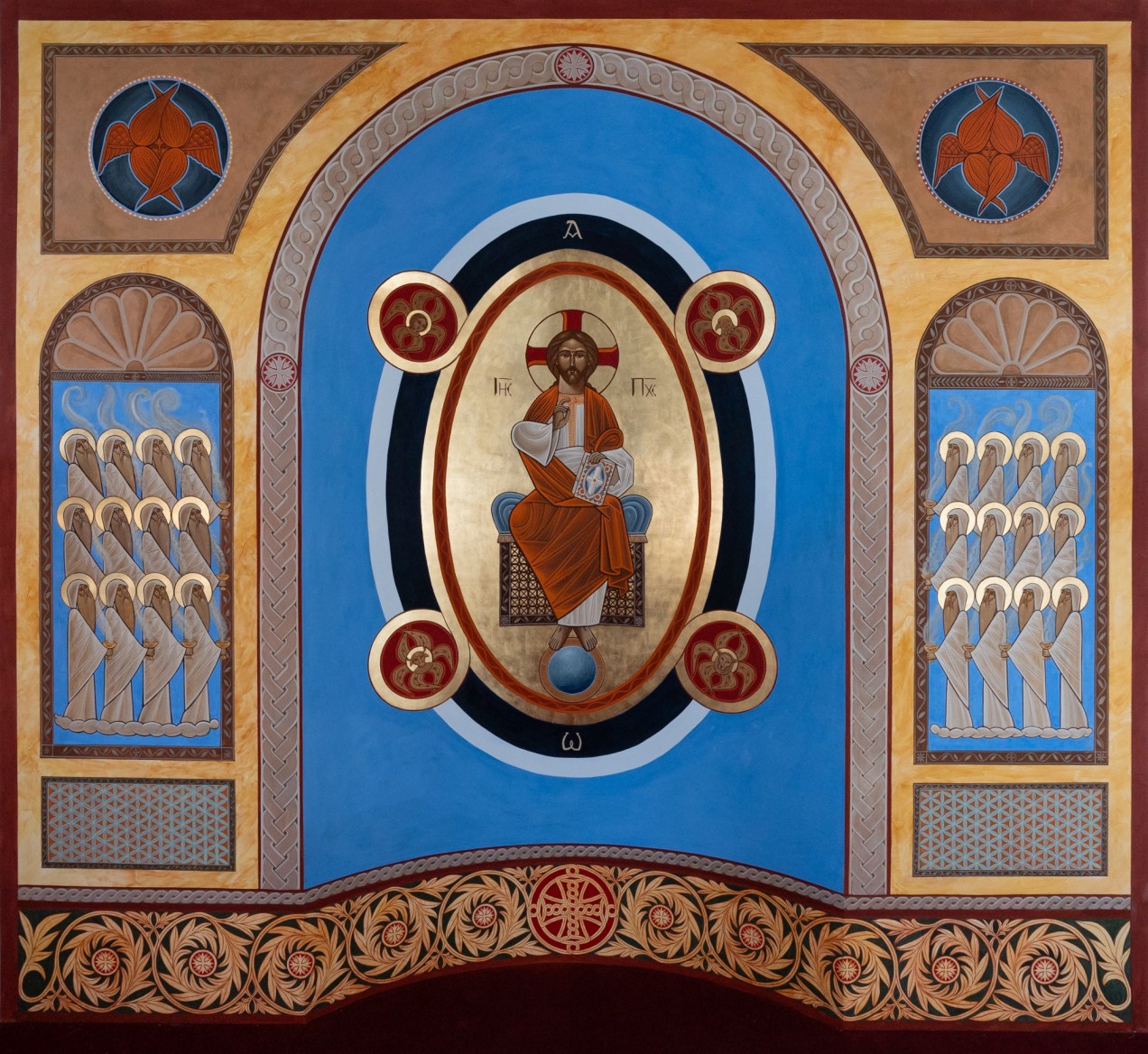
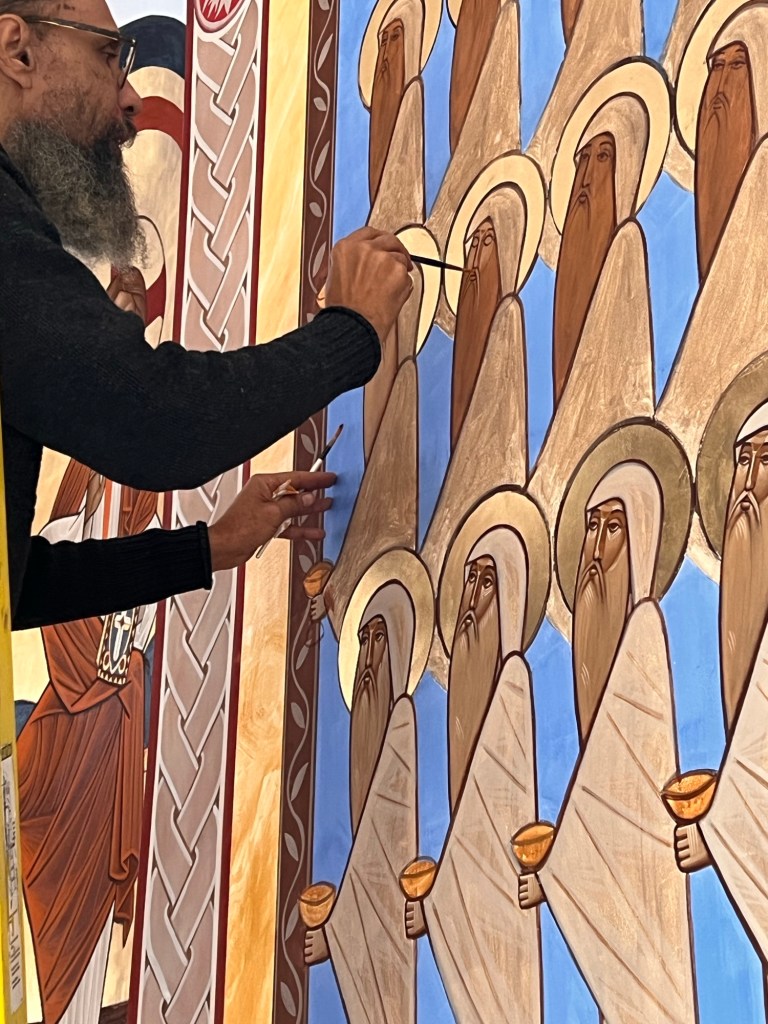
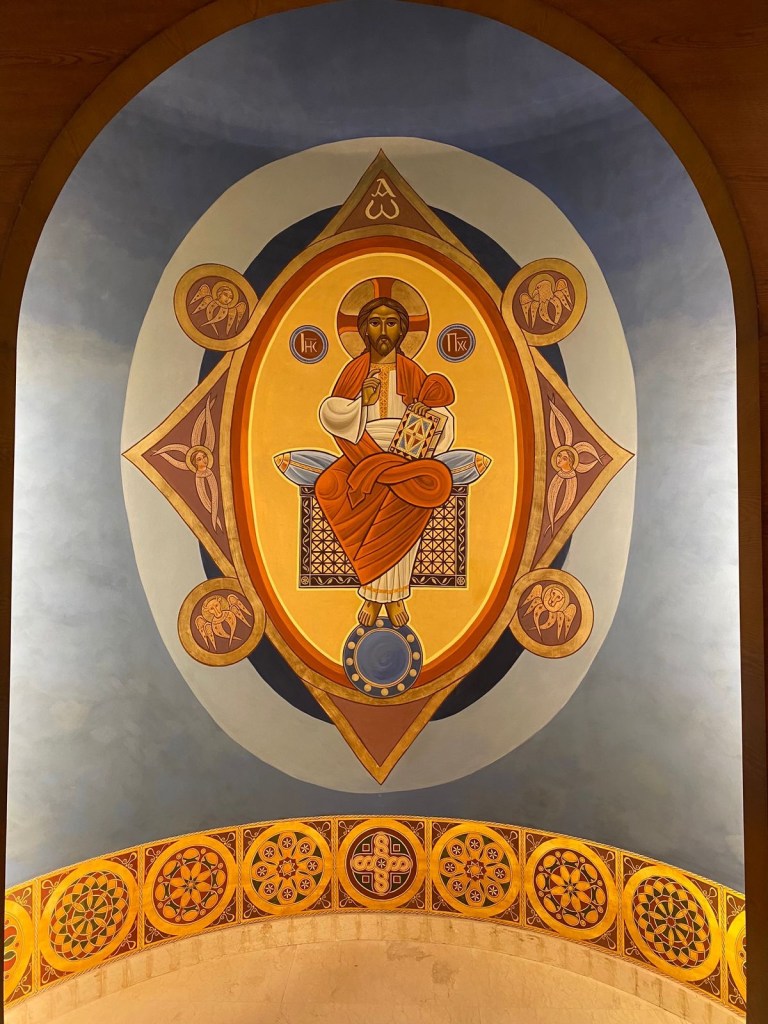
The brief for this project was to create a design of Christ Enthroned surrounded by the Four Creatures in the central apse, flanked by 12 Elders of Revelation on each of the side walls, in a kind of giant triptych. The overall painted surface represented roughly 30 M2. The apse was executed in the traditional technique of egg tempera and took 6 weeks to complete.
Pantocrator triptych, egg tempera
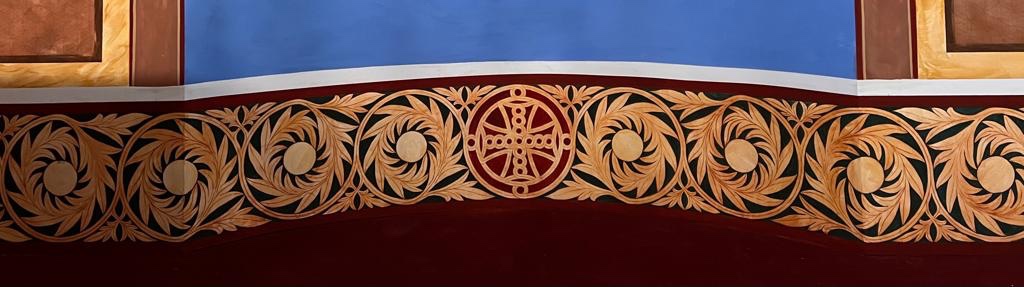
Video produced by Emmanuel Centre, NJCentral panel SeraphBiomorphic decorative friezePainting the Elders of Revelation
Many thanks to the clergy and congregation of St Mark’s and the Emmanuel Centre, Jersey City, NJ, for their kindness and support during the creation process.
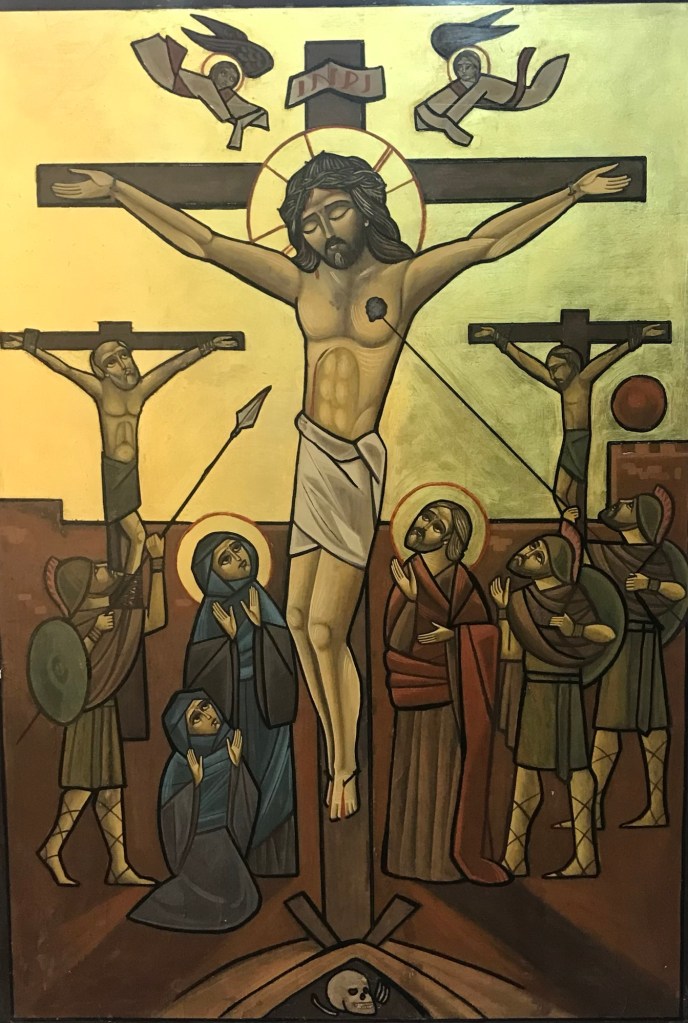
I first became acquainted with St Mary Garden City in 1986, when Dr Isaac Fanous took Monica and I to the church for a special visit to show us the icons he had been doing here since the beginning of the 1980s, some of which I had helped him prepare and had watched him paint in the atelier. A little later, in 1987, he asked me to paint a triptych icon of the Crucifixion for St Mary’s Dekat-El-Salabôt under his supervision (a wooden stand with icons of scenes of the Crucifixion, only used on Good Friday). I was pleased to see this triptych is still being used every year and is still as fresh as the day I finished it.
Crucifixion central panel 1986
The 1980s were an important decade for Isaac Fanous, who saw his work output grow exponentially and internationally. Although already well-known in Egypt and with a growing reputation in the Diaspora since the early 1970’s, the 80s saw his work undergo a subtle but significant stylistic evolution, exemplified at St Mary Ard El Gulf, Heliopolis or Sts Peter and Paul in Tanta, among many others. St Mary Garden City’s icons form an invaluable collection of master pieces by one of -if not- the greatest Coptic artist of all time. In my humble opinion, St Mary’s icon collection encapsulates a crucial phase in the development of the contemporary Coptic style, or as I like to call it, the “Fanoussian” style.
St John the Forerunner, Isaac Fanous circa 1983
The Iconography of St Merkurios Abu Sifain
Lightning process of the Holy Face
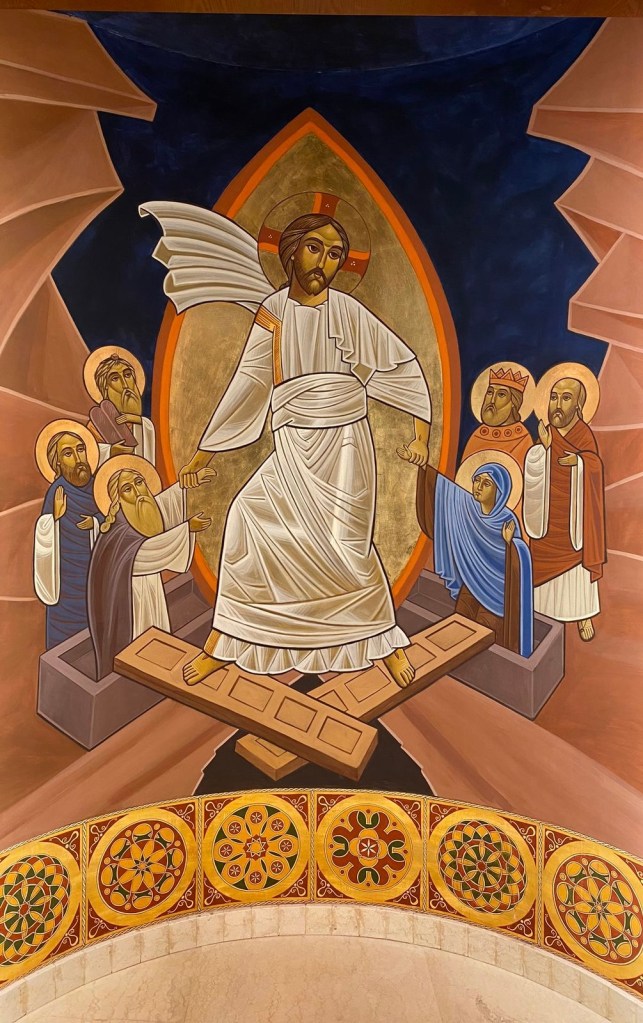
As above mentioned, my relationship with this church started in the mid 1980s as a student and if someone had told me then that I would be doing this work some 37 years later, I probably would have joked it off. The project seemed at first impossible and some logistic problems had to be solved, such as which indispensable materials were or weren’t available in Egypt. But all obstacles were eventually removed and we arrived in Cairo on 2 July 2023. This was my first visit to Egypt in 33 years. Our first impression of the site was very positive. Although still unfinished, I was very pleased with the overall feel of the place, the proportions of the domes and apses, the use of noble materials like rough and smooth marble contrasting with wooden panels adorned with simple Coptic cruciform geometry and lattice panels (musharabiya). Subtle touches like the hidden lighting behind the frame of the three apses, I had never seen used before in a church building. The designer Sherif Morgan, clearly understands the effects of lighting in creating an atmosphere conducive to prayer and worship, as well as enhancing the iconography. Our brief was to create the iconography for 3 apses and 3 domes as phase 1 of the project. Phase 2 would be the iconostasis and phase 3, 8 icons around the nave. All works were executed in the traditional egg tempera technique or secco. Concerning the 3 apses the chosen subjects are as follows: Christ in Glory Pantocrator in the central apse.
Christ Pantocrator
In the right hand apse is the Transfiguration and the Anastasis (Descent into Hades) in the left. These 2 side subjects were chosen as they are pivotal moments in the story of salvation. The Transfiguration is the icon of light par excellence and represents theosis or spiritualisation of matter, when heaven and earth are united. The transfigured Christ is flanked by Moses who stands for the law and Elijah who represents the prophets. Peter, John and James, depicted below, are blinded by the divine light and shield their eyes with their hands. Though they are not transfigured themselves, they nevertheless bathe in the uncreated light emanating from the Christ and are made witnesses of the event.
Transfiguration
The other apse contains the Anastasis, which means Resurrection in Greek. It is also sometimes called Descent into Hades or the Harrowing of Hell. It depicts Christ raising the righteous from the dead and liberating those who had been waiting in the grave for His coming. With His right hand He raises Adam and with His left, Eve. He stands on the broken gates of hell that have fallen down in the shape of the cross. Old Testament figures are featured in the icon to strengthen the narrative. Their number can vary according to the space available. Christ is the main protagonist in the icons of His life’s events and is therefore always the largest figure in the composition. It should be noted that the Descent into Hades takes place while His body lays in the grave just after the Crucifixion and therefore takes place outside the body in the non-physical realms outside of time and space.
Resurrection- Anastasis
The domes
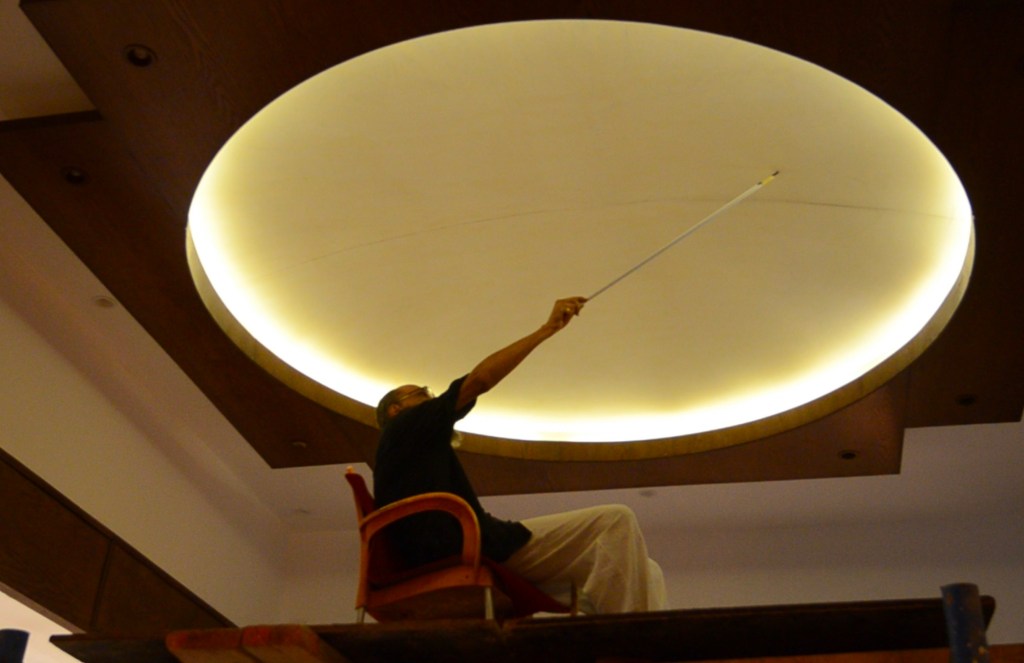
The subjects of the 3 domes were discussed at length with Bishop Rofail, whose diocese includes St Mary’s, because the subjects I proposed were a little unusual in modern Coptic Churches. For the central dome, right above the altar, I proposed the icon of the Virgin of the Sign, according to Isaiah 7:14 and also Matthew 1:23 :”Behold, a virgin shall be with child and shall bear a Son, and they shall call his name Immanuel”. This subject is not foreign to Coptic iconography by any means and there are historical precedents.
Designing the central domePlatytera, Central dome, 3.60m diameter View of dome and apse from the altar
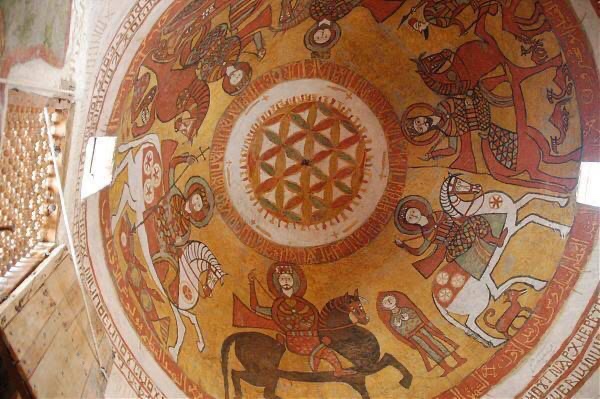
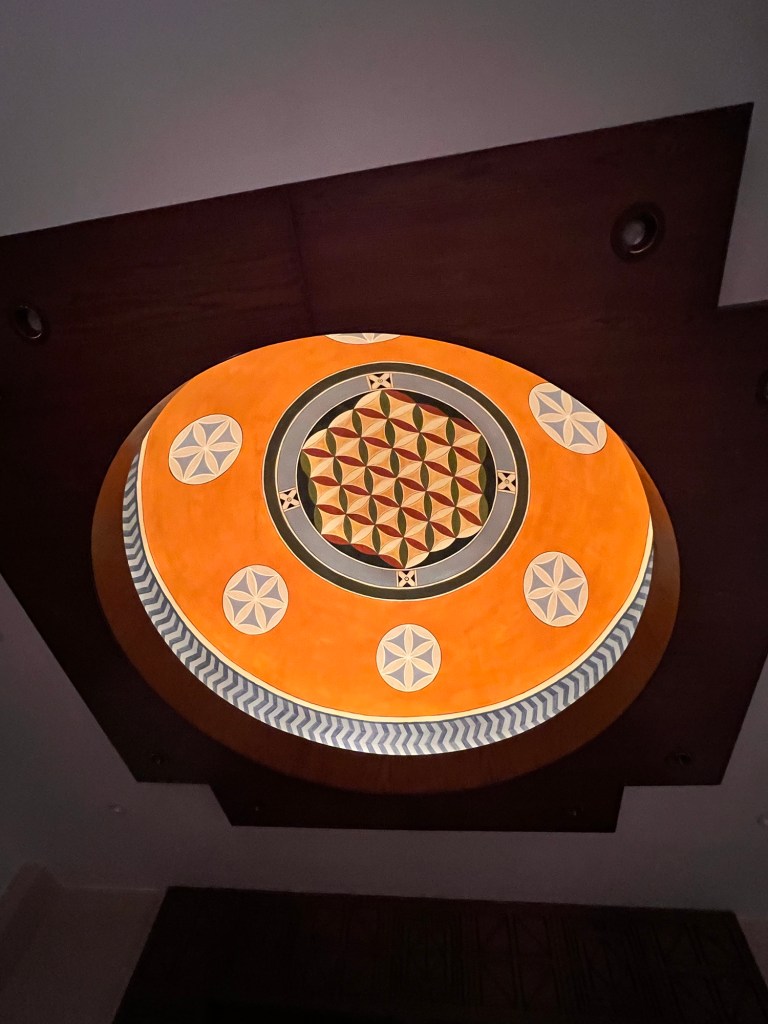
The 2 side domes contain 2 versions of the Primary Pattern also commonly known as the Tree of Life. The Primary Pattern is a very interesting subject that will be discussed in another post, as it really deserves a dedicated blog entry. It suffices to say that although it is found in numerous ancient cultures, it is particularly true in the case of both Ancient Egyptian and Coptic cultures. The idea of using the Primary Pattern was inspired by the famous dome of St Paul of Thebes Monastery in the Red Sea Desert.
Main dome, St Paul of Thebes Monastery
The domes were designed and executed under my supervision by Calum Rees Gildea, including the several geometric panels bordering the lower register of the apses.
Calum painting of pattern 1 Primary Pattern 1Primary Pattern 2
I thank God for the opportunity of doing this work. I also wish to thank my 2 brilliant assistants Daniel Wild Corbett and Calum Rees-Gildea for their support and dedication, as well as all the wonderful people of the congregation of St Mary’s Garden City and last but not least, H.H. Pope Tawadros II and H.G. Bishop Rofael for their enthusiastic support in the project.
Photographs by Daniel Wild Corbett
Consecration of the Pantocrator by H.G. Bishop Daniel
As a senior practitioner of the Neo-Coptic Style as taught by Isaac Fanous, I receive regular enquiries from people seeking advice and/or tuition in this particular style of iconography. All are disappointed and perplexed as to why it should be so difficult, if not impossible, to find a decent course on the subject, while Byzantine icon courses are so plentiful, some even with excellent masters.
There is an increasing number of Coptic youths eager to study and practice iconography. They lament the nearly total lack of information on the subject, leaving them with no choice but to go it alone using models and a plethora of techniques found online, or else join the nearest Byzantine course. What they do not realise however, is that they will not be able to switch from one style to the other, from one tradition to the other, when they feel like it. Although related through faith and history, the Byzantine and Coptic iconographic traditions are very different from each other, like the languages or spices of different cultures. Yet, there is generally no other choice available to them in most cases. Even if they attend a 5 or 10 day course, they will learn nothing of substance in such a short time. In addition, personal practice is of the essence and a rigorous regimen needs to be implemented under supervision if any progress is to occur. Still technique is one thing, but theory is another and the latter is arguably as important if not more important than the former. But the vast majority is mainly interested in learning painting technique, the know-how rather than the know-what or know-why. These three aspects of knowledge (discipline), the know-what, know-how and know-why, perfectly complement each other like three facets of the same stone, so to speak. But if one of the three is subtracted from the equation, it immediately creates a problem – for example knowing what to do, but not how to do it or why, or any other permutation, will lead to the same negative outcome. That is why appropriate education is so important to hold the three in balance for optimum results.
In the West, those who are specifically interested in studying Neo-Coptic iconography will not find anything remotely related to it on any of the available art college courses. Entrenched in post-modern secularism and political correctness, Western art colleges do not consider Christian art as a living tradition, let alone worthy of a dedicated course.
So acute is the need that I once considered starting an online course, perhaps through an online Coptic academic platform. It seemed like an excellent idea at first. But after careful consideration, I concluded that the online format failed to take into account that iconography is a studio-based practice and requires an analogue studio/building where students can try their hand at gesso making, drawing, using pigments, as well as attend lectures and discussions on its various aspects. These basic practical studio activities are unfortunately not possible in a virtual classroom.
The Department of Art & Archaeology at the Institute of Coptic Studies Cairo, headed by Isaac Fanous was the epicentre of Coptic art for 50 years and provided precisely what my enquirers desperately seek, i.e. a place to study the liturgical arts of the Coptic Orthodox Church, both theory and practice. I was greatly fortunate to study there for 8 years in the 1980s and will never forget the powerful and highly inspiring atmosphere pervading the place. The studio was a hive of activity: students were busy helping in the preparation of large icon panels, gilding, laying down the proplasmos (underpainting) after Dr Isaac had completed the designs. Everything was done under his meticulous scrutiny, as there was no room for mistakes. Work went on 6 days a week. Many of Dr Isaac’s icons now considered heirloom master pieces of contemporary Coptic art, were painted during this very prolific period of the 1980s (See Fanous Claremont Coptic Encyclopaedia).
This is the ideal way to study iconography, getting hands on experience in a busy studio and most especially under a great master. Of course it is not the only way to study it, but it is by far the most preferable, as well as the most traditional/ancient. The way things are currently shaping up, it would seem unlikely that this kind of environment could be replicated in the contemporary Coptic context. There are however some activities still taking place in the now modernised art department at the Institute of Coptic Studies. Yet even with the cosmetic facelift, it is only a pale shadow of what it was in its heyday. The fact that it is no longer the epicentre of Coptic iconography is not meant as a criticism or the fault of any individual, but a mere observation by simple before/after comparison. Taking a cursory look at the art of the recently completed St Mark’s Cathedral is enough for the informed eye to realise that, as the expression goes, things ain’t what they used to be.
In Australia, H.G. Bishop Suriel, Coptic Bishop of Melbourne, is still until this day the only Coptic Bishop in modern times to have included iconography as an integral part of a Coptic diocese. An author and scholar in his own right, Bishop Suriel is a strong believer in the preservation of tradition through education. Under this ethos he established St Athanasius Coptic Theological College (SAC) in the early 2000s, to provide “quality theological education in the Orthodox Alexandrian tradition” according to the College’s website. SAC has a physical campus and its courses have been accredited by the University of Divinity, Australia, since 2011. Bishop Suriel took the unique initiative of including Coptic iconography as part of the curriculum. The course is led by my colleague and friend Ashraf Gerges Fayek, whom I first met in Cairo while we were both students of Isaac Fanous during the 1980s. To avoid the kind of situation befalling the vast majority of Coptic churches around the world with regards to bad and/or heterodox iconography, Bishop Suriel appointed Ashraf as his head iconographer and made him responsible for all matters regarding iconography in the diocese, thus eliminating the problem in one master stroke. This is the very best way to insure the survival and further development of Tradition and H.G. Bishop Suriel should be commended for his far sighted vision and understanding of the issues at stake. Such initiative however, relies solely on whether the iconographer in charge is appropriately educated, qualified and experienced and more importantly, whether he/she, like Ashraf, follows the precepts and canon established by our teacher Isaac Fanous and not their own personal brand. How many of us are left today still practicing and/or teaching the Fanoussian canon? I’d love to hear from them.
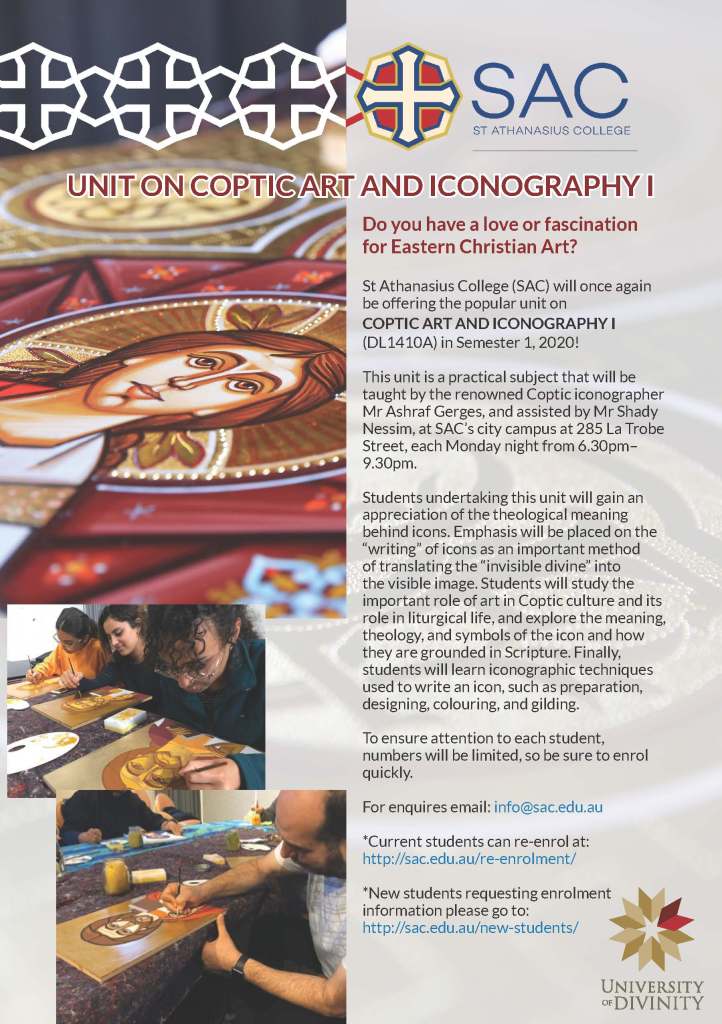
Announcement for the iconography course at St Athanasius College, Australia
There was a glimmer of hope in California during the mid 1990s when something concrete and far reaching could have been done with regards to iconography. At the time my wife, Monica, was doing her PhD research on Coptic heritage and the legacy of Isaac Fanous at the School of Oriental and African Studies (SOAS) in London. Her planned field trip to Egypt had been cancelled because of Gulf War 1 and she had been sent to Los Angeles instead, to look at the Coptic presence there. As it turned out, Isaac Fanous had been in LA for a while, in the middle of completing what has now become his most famous work at Holy Virgin Mary Coptic Orthodox Church in Highland Park. We stayed with him in the old wooden cottage provided by the church until he went back to Cairo, then continued our work in California for another 4 years on and off.
It was during this time that the diocese of Southern California and Hawaii was created and H.E. Metropolitan Serapion (then H.G. Bishop Serapion) was enthroned as its bishop. We were already acquainted with H.E. Serapion, as he had kindly given Monica some assistance while working on her MA project in Old Cairo in the 80s, when he was Bishop of Social Affairs . It was Fr. Antonios Henein of blessed memory, head priest at Holy Virgin LA and an unconditional supporter of Isaac Fanous and the Neo-Coptic movement (see Claremont Encyclopaedia, Isaac Fanous), who organised some meetings with Bishop Serapion, Monica, Fr Bishoy Brownfield and myself with a view to creating a studio of iconography in the diocese that would include an educational programme as well as the possibility of training apprentices, similar to the above described model implemented by H.G. Bishop Suriel in the Diocese of Melbourne. Let us further bear in mind that these were the mid 1990s and that Isaac Fanous was still very much active and would remain so for the last 10 years of his life, mostly in Southern California. He would have been fully involved in the project from the start, since this was one of his dearest wishes and the subject of many a conversation over the years. Since California has numerous large purpose-built churches as well as remodelled ones, it would have created the perfect ecology for iconography to flourish. Unfortunately, no steps were taken, the project was forgotten and the status quo remained. This had the unintended consequence of turning the Diocese of Southern California into a museum of Isaac Fanous’ work, instead of a living, thriving centre of Coptic iconography. By the same token SoCal became fertile ground for the kind of “innovations” described in a previous post here https://copticiconography.com/2020/01/23/coptic-iconography-in-the-age-of-social-media/
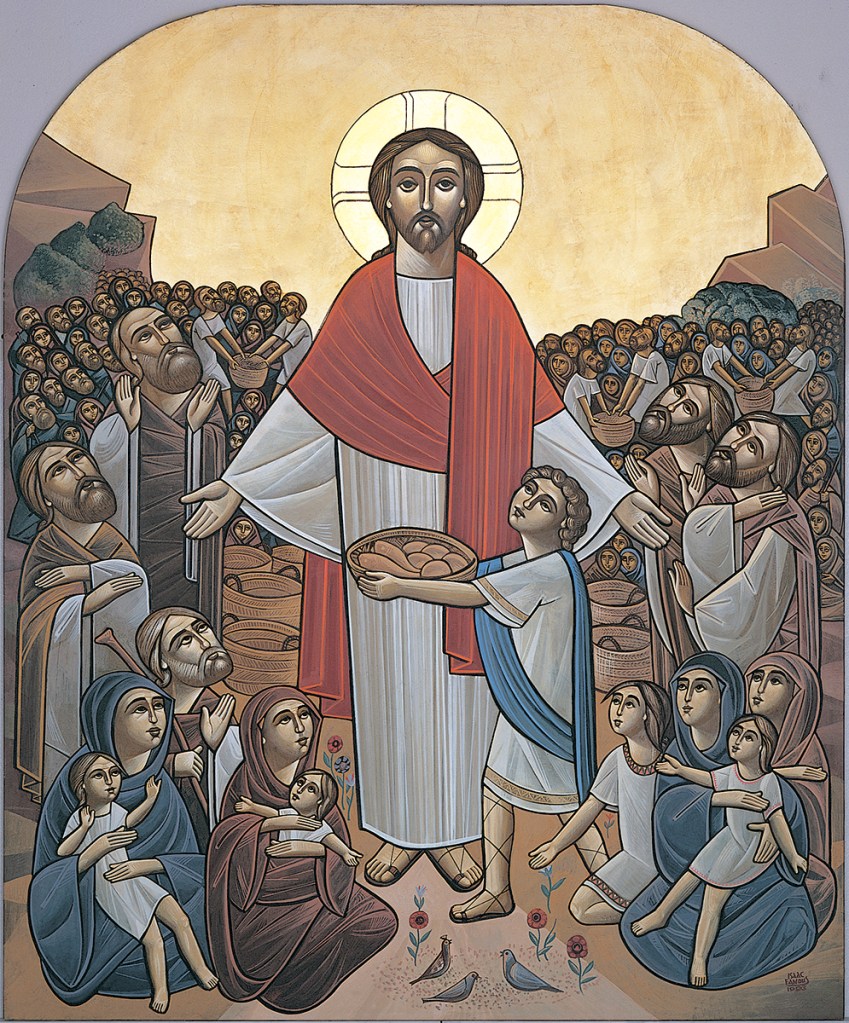
The Feeding of the Multitude, Isaac Fanous, Holy Virgin Los Angeles
When speaking of education, let us note that iconography is still largely considered a hobby in the Coptic Church or an extra-mural activity. According to this way of thinking, it follows that one is not required to pursue any particular course of study, hold any degree or qualifications in order to practice in the church. Consequently there is no standard of excellence to strive towards as every/anyone is allowed to do as they please and more or less how they please. As discussed elsewhere in this blog, the post-Fanous era is in many ways much worse than the pre-Fanous period because of the unbridled proliferation of uninformed/misinformed iconography through social media among other things. This is not to say that there is no talent in the Coptic church, far from it. The problem is that whatever talent there is is not fostered, channelled or educated to achieve its best potential and the high level of excellence iconography demands. Rather it is left with neither discipline nor discipleship which are the very building blocks of a living artistic tradition and the main vehicle of transmission of tradition. Whether this is by design or by default, I cannot say, but the results are certainly plain to see…
N.B. this post is mainly concerned with the basic study of iconography, not graduate and post-graduate studies.
I am the good shepherd; the good shepherd layeth down his life for the sheep. John 10:11
Neo-Coptic icon of the Good Shepherd, egg tempera on gesso
A Coptic Orthodox friend requested an icon of the Good Shepherd recently. I had already painted one many years ago for a Roman Catholic church of the Good Shepherd in Oxfordshire and I was glad for the opportunity to revisit the subject from an Orthodox perspective.
The Good Shepherd seems to have become a dominant theme in Coptic iconography over the last few years. It is found in several important new Coptic sites, most notably on the exterior façade of St Mark’s Cathedral, Cairo. By virtue of this new ubiquity it would appear that the subject, in a particular form, has now been canonised into the contemporary Coptic iconographic repertoire. To my knowledge, it is not a traditional Coptic subject and I have never come across it in my own research into historic Coptic iconography. Even in the contemporary era, Isaac Fanous only painted it once or twice in 50 years at most. Therefore I thought it would be useful to take a quick look at the image, its origins and symbolism.
The theme of the shepherd carrying a lamb/sheep/ram was already current in pre-Christian times. It was actually one of the epithets of Hermes, as Hermes “kriophoros” meaning ram-bearer or ram carrier. The ram of course, is a reference to the Theban deity Amon and to the astrological sign/aeon of Aries the ram. The Old Testament is replete with Ram/sheep/shepherd related symbolism, one of which is King David, the Shepherd King. Some of the earliest Christian images of the Good Shepherd are found in the Roman catacombs and depict a youth carrying a lamb/ram/sheep on his shoulders, alone or walking among his flock. The style of iconography is classical and because of this fact, it is not readily recognisable as Christian. It is therefore ambiguous, perhaps purposefully so, for fear of persecution by the Roman authorities. The question arises in the viewer’s mind: ” Is this the figure of Apollo or Hermes, or some other Roman deity? We can therefore surmise that only converts knew that the true identity of the figure was Jesus of Nazareth, the Son of God.
Shepherd scenes, catacombs of Priscilla, Rome ca 225 AD Note the Shepherd on the left carries a ram, not a lamb
There are two main ways of depicting the Good Shepherd image, one is the Roman (and now Coptic) way, the other is Byzantine Orthodox.
The Roman/Coptic model sets the scene in a pastoral landscape, with a stream or river, trees, flowers etc… Christ holds a lamb in his arm and is surrounded by a docile flock peacefully grazing. This model is obviously based on the frescos in the Roman catacombs, with copious addition of the realism and sugary sentimentality usually associated with Roman art… The symbolism is weak, surface deep, whether done in the Roman or Coptic style. Furthermore, it only addresses the first part of St John’s verse “I am the Good Shepherd”, leaving out the most important second part “…layeth down his life for his sheep”. The image as presented today in the Coptic Church is based directly on this Roman model (see previous post on Roman art vs Orthodox iconography where the issues are discussed in more details)
Left, Roman style painting of the Good Shepherd. Right, mosaic of the Good Shepherd on the exterior façade of St Mark’s Cathedral, Cairo.
The other and, in my humble opinion, truly canonical way of depicting the subject is found in the Byzantine tradition. As in Egypt, the Good Shepherd was never a historically prominent theme in Greece or Russia, but whenever it is used, its symbolism is very potent, weighty in visual theology and mystical undertones. Firstly and chiefly, the cross is added to the composition. The addition of the cross placed behind the Saviour, changes everything in terms of meaning and firmly places the image in the eucharistic context. He carries the “lamb without blemish”on His shoulders, placed at the centre of the cross, as if hanging from it. Here the lamb becomes a symbol of the sacrificial aspect of Christ, as He Himself is the lamb that lays down His life so that many should live. To further anchor this point, Christ bears the wounds of His passion in His hands. In this icon, He is seen simultaneously as the Good Shepherd and the sacrificial lamb. The symbolic content in this composition adequately addresses both parts of the verse in John’s Gospel, i.e. the Good Shepherd as well as His sacrificial aspect, without any sentimental drivel whatsoever.
Greek Orthodox icon of the Good Shepherd
Since there are neither historic nor Fanoussian Coptic prototypes of the image of the Good Shepherd, I chose to follow the Byzantine type simply because it is Orthodox and theologically correct and encrypted with profound symbolism. The Latin model on the other hand, while making a pretty bucolic picture, is otherwise shallow, mostly form without content.
I joined Facebook when it first started in the mid 2000s, but stayed inactive for years because I found it uninteresting and useless. It all changed when the Egyptian revolution v.2.0 happened in 2011, because social media became the best way to follow events and hearing about them directly from friends and people who were experiencing them firsthand. By then Facebook had literally exploded into this humongous social media phenomenon and the whole world seemed to be on it, certainly the whole of Coptic Egypt. Through Facebook I was easily able to monitor what was happening in the Church with regard to iconography. Soon I began to see hair-raising stuff in terms of bad iconography and the misuse of symbolism, even the outright plagiarism of Pharaonic symbols and much more I will not mention. Prof. Fanous’ passing in 2007 seems to have opened the floodgates and released a tsunami that had previously been held back by the established order he represented. Now that he was gone, this tsunami was unleashing on Facebook and I have watched it swell-up ever since. Even though I do sometimes share some of my own work, over the years I have come to the conclusion that the Facebook phenomenon has had a particularly pernicious effect on iconography, especially on contemporary Coptic iconography, which unlike its Byzantine counterpart, is still in its infancy, in a state of flux and with as yet no firm canon. To a large extent, social media has unfortunately contributed to the trivialisation and cartoonisation of Coptic iconography.
In this context, errors are made by one and copied by others, who in turn pass them on, like some infectious viruses creating an epidemic of bad iconography. Repeated often enough and enthusiastically shared by enough individuals, these errors eventually become the accepted norm, like a lie can become truth, merely through continuous repetition… Iconographers are now literally created on Facebook, legitimised by a selfie with the Patriarch or a bishop as a profile picture and confirmed by the number of likes, followers, compliments and shares. Many even post their practice doodles or their first shaky attempt at icon painting… Yet others spread their name and phone number writ large across the image to solicit business, like higglers in a virtual Khan El Khalili bazaar… Is this the appropriate way to treat sacred liturgical art, like mere commodities on a market place?
A growing Coptic Facebook related trend is dubbed “digital iconography” by its practitioners and spreading on social media. These “digital icons” are created on computer based graphic applications, usually on a tablet. It requires basic computer skills, which most young people have these days. The style varies from individual to individual, and more importantly, there are no rules to follow or respect. One such digital image accompanied the headlines internationally in recent years when Islamic State terrorists gruesomely beheaded 21 Coptic Christians in Libya. Because of the speed of computer graphics as opposed to the traditional techniques and the ease of social media publishing, the image went viral within hours of the event. It was even printed, censed and carried in procession in Coptic churches around the world. Please note I am not discussing the tragic Libyan event here, only the response it triggered with regard to iconography in the Coptic context. Nor am I criticising the author of the image whose heartfelt and spontaneous response was to create the image and post it on his Facebook page and was himself astounded by the viral response. Some of these “digital icons” are strongly influenced by contemporary trends such as manga, a Japanese cartoon style favoured by millennials. Others are just copy/paste jobs of existing “analogue” icons with the author’s personal touch added to the original. The vast majority lack content and prioritise form over essence. There is even a priest in California who designs and prints his own digital images and sticks them on the walls of his church.
I could go on describing the myriad of ways genuine Coptic iconography is being besieged by the current wave of technological charlatanism. Many however call these images “icons” and consider them as valid as traditional icons. When I try to explain why they should not be called icons, I usually get very negative reactions and told why they should indeed be considered icons. I will therefore take the opportunity to set the record straight and explain why they are not and will never be icons.
Manga computer cartoon character and a “digital icon” of the Virgin & Child by Mina Anton. The manga influence is obvious and strong
In the Coptic Orthodox tradition, an icon is considered to be a liturgical object and as such must go through a consecration ritual to be anointed with holy chrism by the Patriarch or a bishop – the same is true for the altar, the holy patten and vessels, the iconostasis and even the walls of the building. On that basis alone, it is clear that these digital graphics can never be considered icons in any liturgical sense of the word, because they are only lines of 0s and 1s stored on a computer’s hard drive. Although the iPad may make the user feel he/she is an iconographer, one should not mistake virtuality for reality. Moreover, the whole process of making an icon is as important as the finished product. The technique itself is full of profound symbolism, which cannot even begin to be approached on an iPad. These reasons and more, are why these images cannot and must not be called “icons” or be used in a church, masquerading as liturgical art. If things continue as they are, Coptic icons of the future will be made by AI and displayed on LCD screens or 3D projection devices, thus by-passing the need for both the human hand and human soul.
Digital print being prepared to be stuck on the ceiling in a Coptic Church, California
Also connected to the above is another trend that should also be mentioned here. It concerns the increasing use of very large architectural laser printed reproductions of icons and/or monumental mural paintings, instead of commissioning new works. At least some of these reproductions are of the work of Isaac Fanous and therefore beautiful and correct. Yet they stop the tradition from being practiced and passed on. This technique seems to have become a standard practice for a growing number of new Coptic churches in the US, especially in California where the trend started. Photographs of whole iconostases are printed on screens resembling roll-up exhibition display screens. I also recently saw a video of the installation of a large Pantocrator, approximately 4 to 5 metres high, being unrolled and stuck in the eastern sanctuary apse of a Coptic church, a process which took no more than a few hours, half a day at most, as opposed to the many days/weeks it takes to paint a real one. This I’m told was only a temporary measure, but some however see it as a shortcut to having instant iconography on the cheap. Actually not all that cheap, but somewhat cheaper than the real thing, but with only a tiny fraction of durability, 10s of years as opposed to 100s or even 1000s. It should be noted that such practices are the best way to ensure the disappearance of the icon-painting tradition, and reducing it to mere interior decoration, like some theatre stage design, i.e. it appears to be real, but it’s only an illusion, a make-belief or pastiche. Like all goods in our consumer society, this is throw-away iconography which of course, and contrary to church tradition, cannot be consecrated and anointed with holy chrism. Such practices, temporary or otherwise, represent yet another nail in the coffin, since iconography only thrives through demand and supply. Such trends if continued long enough, will easily spell the end of it.
As long as there are no established standards, fads such as these will continue to creep in, as the intention is obviously to by-pass the proper study of the tradition by hooks or by crooks, by any innovative/progressive means necessary. This is certainly not the correct way to achieve a canonical contemporary Coptic Orthodox iconography fit for liturgical use. Iconography and hymnography, like the liturgy itself, must/should not be subject to transient fashions and individual whims. But that is unfortunately the perplexing reality in AD 2020. Perhaps it is time to pause and reflect on the meaning and place of Tradition (with a capital T) in the contemporary Coptic Orthodox church.
As always, what is so obviously and profoundly needed is education, not only towards the forming of future iconographers, but for the clergy too, who should be given strict guidelines regarding what is and what is not acceptable in an Orthodox church, since they are ultimately responsible for what is allowed inside a Coptic church building. However, any move toward better education must be preceded by an acknowledgement that the problem exists. Until then Coptic iconography will remain rudderless and will continue to fall further into a state of decadence and confusion, a state worse than the barrenness of the pre-Fanous era.
In considering the transmission of a sacred artistic tradition such as iconography, it is necessary to consider the master-disciple relationship, or discipleship. Discipleship has always been central in the forming of traditional artists and craftsmen, normally over years rather than weeks or months. All the great world sacred artistic traditions acknowledge discipleship as vital in the process of transmission of knowledge from master to disciple and hence, from generation to generation. It was indeed so in Ancient Egypt, as the records show; teams of craftsmen and artists of all disciplines worked under the keen eye of their respective team masters and over 3 millennia created the greatest artistic heritage in the history of the world. This could only have been achieved through the three fundamental principles, namely apprenticeship, discipleship and mastery.
The concept of discipleship is very much at the heart of Christ’s teachings and of the way they were propagated throughout the world. Coptic history is replete with examples of discipleship too numerous to mention here. All Coptic Christians have heard of St Shenouti and his disciple Wissa or St Makarios the Great and his two young Roman disciples, Maximos and Domadios. Another important case in point is the famous School of Alexandria, called Didascalia, where some of the most important church fathers like St Basil, St Cyril of Alexandria, St Gregory of Nyssa and many others, sat at the feet of their teacher Origen. The sacred art of icon-painting is the visual expression of the theology established by these church fathers. By virtue of this fact, it should be considered and treated as a spiritual discipline and as an integral part of the spiritual and liturgical tradition of the church, not just a self-taught hobby or a personal artistic pursuit.
The word disciple comes from the Latin discipulus, which means learner. A related word is discipline from the Latin disciplina, meaning instruction, referring to knowledge received through instruction. Hence a disciple is one that acquires knowledge through discipline. The most important element in this equation of course, is the source of that knowledge and the instruction through which it is conveyed, namely the teacher/master who embodies and transmits it correctly. Without this synergy of discipulus and disciplina, the continuous thread of tradition is cut and it can no longer be passed on and disappears. This is precisely what happened to the Coptic painting tradition in the 19th c. (see Coptic Civilization AUC 2016 chapter 21 for more details). Sadly, it is also what is in the process of happening again as these lines are being written.
One day early on in my studies, while walking from the studio to his nearby home for our lunch break and chatting about general studio ethics, Dr Isaac said to me: “outside of the atelier, I am your friend, but inside the atelier, I am your master. You must never forget that!”. I never forgot it and today, some 38 years later, I still consider myself his disciple and will probably do so for the rest of my life. Without his guidance, profound knowledge of the tradition he embodied and his great generosity, I would never be who I am today and would certainly not do what I do or know what I know. I am therefore eternally grateful to God for this unique and unexpected blessing of being his disciple. He didn’t feed me tons of informations or give me books to read or burden me with papers to write. His way of teaching was oral, informal and spontaneous. However, he always encouraged me to do my own research while gently prompting me in the right direction during our discussions. During of of these conversations he said : “a master does not give his disciples ready-cooked fish, rather he teaches them how and where to catch it for themselves. This metaphor is very profound and reminded me of the passage in the Gospel of John when Jesus tells His disciples where to throw their nets to catch an abundance of fish (John 21:6). In our context, it refers to the master giving his disciples the right tools and informations to discover the beauty, proportion and truth, in and for themselves. The master-disciple relationship is not based on ego or fear, but on love, mutual respect and trust.
An aspirant should not come with any pre-conceived ideas about iconography. He/she should ‘unlearn’ what they think they know about art, especially if they have a modern art college background. The pursuit of personal fame, celebrity, vanity and all the things associated with an egotistical mindset, are contrary to the spirit of iconography. One should surrender in humility and acknowledgement of one’s own ignorance, like an empty vessel ready to be filled with knowledge and beauty. For how can a vessel be filled if it is already full, especially if full of ego and misconceptions? The mindset and attitude of the aspiring student is therefore of the utmost importance in determining whether they have the aptitude, fortitude, single-mindedness and resolve needed to progress through to eventual mastery, or just temporarily passing through to catch some technique and disappear as soon as they’re satisfied. The latter kind was certainly not favoured by Dr Isaac. (see Claremont Coptic Encyclopaedia entry under Isaac Fanous, Monica René 2019)
As a spiritual discipline, iconography is to be considered a vocation, on the same level as any other ecclesiastical vocation. It is certainly so in the Eastern Orthodox Church. It is not be considered a “job” in the profane sense of the word, or some mundane commercial venture. It would indeed be a grave mistake to regard it as such.
In theological matters, the responsibility of an iconographer is as heavy as that of a priest, since they are both involved in the preaching of the Word, the priest orally, the iconographer visually. There is therefore not much room for innovation or artistic self-expression, unless rigourously subjected to Orthodox tradition and theology.
Sadly and ominously, the current post-Fanous generation of iconographers does not know about discipleship or studying under a master such as Isaac Fanous. Most are self-taught and isolated, picking up tips from other self-taught individuals, who picked them up from someone else. Needless to say the original message gets lost in translation and the end product bears no resemblance to the prototypes. Many resort to Facebook groups to ask for advice since they receive no tuition. The generation who had the privilege and opportunity to know Dr Isaac and to study under him are getting old (myself included) and many do not practice much anymore. The result of this post-Fanous apathy and laissez faire attitude towards iconography is at its most obvious in St Mark’s Cathedral in Cairo, whose iconography was recently hastily completed for its 50th anniversary. This subject however will be examined in a future post.
This year marks the centenary of the birth of Isaac Fanous in December 1919. It has been 12 years since his passing in 2007 that he left the Coptic Church bereft of its greatest ever icon master.
Monica René is a coptologist specialised in the Neo-Coptic School and Prof Isaac Fanous’ only student in iconology. She was commissioned by the Claremont Coptic Encyclopaedia to write its first entry for Isaac Fanous, in celebration of his life and recognition of his unparalleled achievements in the field of Coptic art.
No man is ever a prophet in his own country and as Monica points out in her text, most of the recognition he received for his achievements came from abroad, not from Egypt where he faced a significant amount of opposition and struggles over the years, but none strong enough to stop him fulfilling his life’s work and creating works of staggering beauty and spiritual depth.
I felt I should make clear that this blog is first and foremost addressed to a Coptic Orthodox readership in the hope of raising awareness about important issues pertaining to iconography in the church. Anyone is of course welcome to read or comment on the points raised in posts. I chose the issue of Renaissance/Roman style painting in Coptic churches as a starting point, because it poses one of the greatest threats to the survival of the Coptic painting tradition once revived by Prof Isaac Fanous of blessed memory. It should be emphasised that the contemporary Coptic version of Renaissance art would be best classified as “religious kitsch” rather than Renaissance art, to which it bears only nominal resemblance.
My aim is certainly not to criticise the contemporary Roman Catholic Church, but merely to highlight the kind of art that the Renaissance produced in its name. In Part 1, I suggested that Michelangelo’s Creation of Adam is a heretical work, simply because from my perspective, it flagrantly contradicts basic Orthodox Christian theology. A few readers were actually quite offended by this suggestion and seemed to be experiencing a touch of cognitive dissonance about it: “What sort of uneducated and uncultured individual would write such drivel and dare to criticise Michelangelo and the Renaissance?” one irate individual commented. However I need not apologise in the least for seeing the Renaissance as a spiritual regression or a “Regressance”, to coin a new word, not a rebirth.
The contemporary Roman Catholic Church on the other hand, is currently going through somewhat of a renewal of its own sacred arts. In this context, I should like to mention contemporary Roman Catholic artists and friends such as David Clayton, who’s fascinating book The Way of Beauty (Angelico Press 2015), I highly recommend, or Ian Knowles, founder of the Bethlehem Icon School in Israel, as well as French artist François Peltier to name but three individuals engaged in this great renewal process. Moreover, there are an increasing number of iconographic studios associated with the RC in Europe and America, some of which produce very fine traditional Byzantine icons. I am not suggesting that Catholics (or anyone else) should wholly embrace Byzantine iconography, but any serious enquirer into Christian sacred art will eventually encounter Tradition (with a capital T) in the Eastern or Oriental traditions. There is however no evidence that contemporary Catholics are at all thinking of reviving the art of the Renaissance. In fact the evidence points to the exact opposite, towards a rediscovery of the true pre-Renaissance roots of the Christian artistic tradition.
St Jude by Roman Catholic iconographer Ian Knowles. Ian has a very traditional style and uses the traditional technique of egg tempera on gesso. His work is slightly reminiscent of the Romanesque style The Lamb surrounded by the Four Living Beings (detail of the Conques Triptych) by French artist François Peltier. François has a more contemporary approach and uses modern materials, but his content and vocabulary are steeped in tradition.
It is therefore rather ironic that the art which the Roman Church itself completely abandoned after Vatican II, should still be thriving in the Coptic Orthodox Church today. In my previous post I pinpointed western colonialism as one of the major contributors to this phenomenon, which over 150 years completely replaced iconography in the Coptic church.
Not long after his consecration as Patriarch, H.H. Pope Tawadros II published a short piece in Keraza Magazine (Arabic), in which he cautioned Coptic congregations against the use of western art in Coptic churches, especially in the diaspora, because it does not agree with Orthodox teachings and is not part our Coptic tradition. However, his call seems to have fallen on deaf ears, as things seem to have gotten worse, not better, especially in the diaspora and more specifically in America.
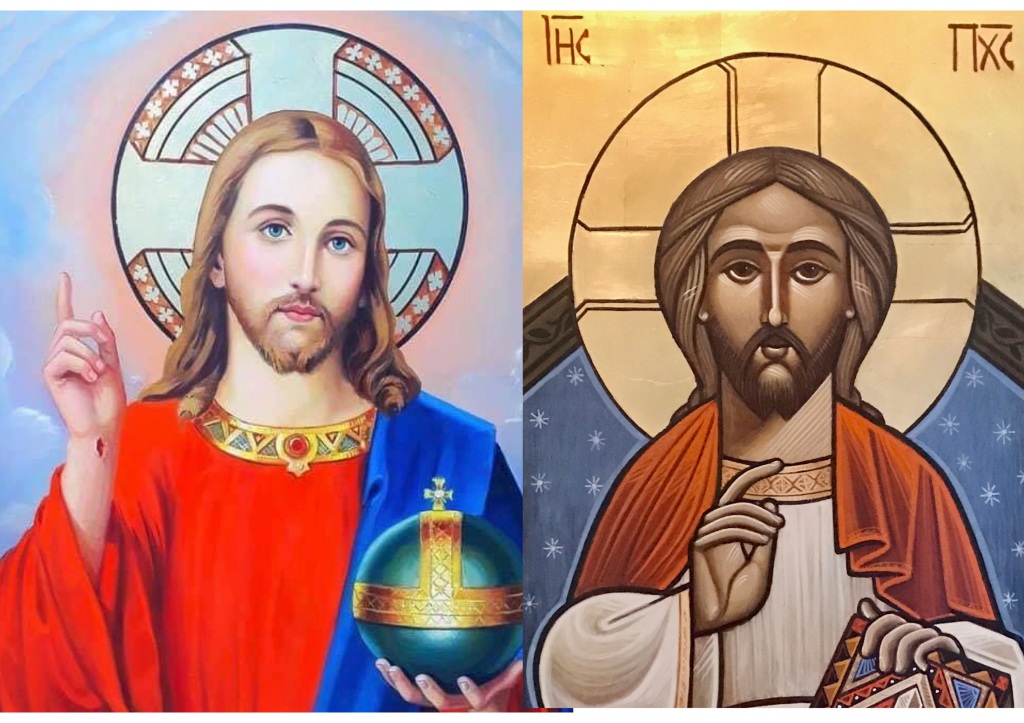
A Roman “religious kitsch” style painting of Jesus with blond hair and blue eyes holding a globe juxtaposed with a Neo-Coptic (Fanoussian) icon of Christ.
An outright Papal ban on Western art in Coptic churches is not an option at this stage as it would go against the majority of the faithful’s wishes. It would also render many artists jobless overnight. Some of these ‘classical’ style painters have practiced hard to do what they do and should not be blamed for doing it. After all, they only fulfil a need and as long as that is forthcoming, they will be busy. Furthermore, they could not be expected to just recycle themselves overnight into iconographers, unlearn what they know (or think they know) and become beginners again. This is a process that takes years of study and practice, presumably under a master – a luxury which is unfortunately no longer available in the Coptic church since the passing of Prof Isaac Fanous. Yet I have seen work by people who dabble in both western and Coptic styles, mastering neither, and others who try to mix the two into a strange hybrid style, presumably to appeal to all… Needless to say this is not the way to foster and maintain correct Orthodox iconography.
I realise that this post raises more questions than it gives answers, but sometimes it is enough to ask the right questions in order for answers to become self-evident.
I thought it appropriate to publish a few of Monica’s photographs taken while we lived and studied in Egypt in the 1980s, as well as saying a few words about her and her work. I chose a handful of my favourite images from her large archives, all originally taken on 35mm and professionally hand printed,… Read more
The brief for this project was to create a design of Christ Enthroned surrounded by the Four Creatures in the central apse, flanked by 12 Elders of Revelation on each of the side walls, in a kind of giant triptych. The overall painted surface represented roughly 30 M2. The apse was executed in the traditional… Read more
St Mary Garden City I first became acquainted with St Mary Garden City in 1986, when Dr Isaac Fanous took Monica and I to the church for a special visit to show us the icons he had been doing here since the beginning of the 1980s, some of which I had helped him prepare and… Read more
As a senior practitioner of the Neo-Coptic Style as taught by Isaac Fanous, I receive regular enquiries from people seeking advice and/or tuition in this particular style of iconography. All are disappointed and perplexed as to why it should be so difficult, if not impossible, to find a decent course on the subject, while Byzantine… Read more
I am the good shepherd; the good shepherd layeth down his life for the sheep. John 10:11 A Coptic Orthodox friend requested an icon of the Good Shepherd recently. I had already painted one many years ago for a Roman Catholic church of the Good Shepherd in Oxfordshire and I was glad for the opportunity… Read more
I joined Facebook when it first started in the mid 2000s, but stayed inactive for years because I found it uninteresting and useless. It all changed when the Egyptian revolution v.2.0 happened in 2011, because social media became the best way to follow events and hearing about them directly from friends and people who were… Read more
In considering the transmission of a sacred artistic tradition such as iconography, it is necessary to consider the master-disciple relationship, or discipleship. Discipleship has always been central in the forming of traditional artists and craftsmen, normally over years rather than weeks or months. All the great world sacred artistic traditions acknowledge discipleship as vital in… Read more
Click on the link to access article in the Claremont Coptic Encyclopaedia http://ccdl.libraries.claremont.edu/cdm/singleitem/collection/cce/id/2162 This year marks the centenary of the birth of Isaac Fanous in December 1919. It has been 12 years since his passing in 2007 that he left the Coptic Church bereft of its greatest ever icon master. Monica René is a coptologist… Read more
I felt I should make clear that this blog is first and foremost addressed to a Coptic Orthodox readership in the hope of raising awareness about important issues pertaining to iconography in the church. Anyone is of course welcome to read or comment on the points raised in posts. I chose the issue of Renaissance/Roman… Read more
Christ in Glory or Pantocrator (Almighty), is arguably the most important icon to be found in a Coptic Orthodox church. It is always found in the central Eastern apse of the sanctuary. The image of Christ in Glory has remained more or less unchanged in content since at least the 6th century and possibly earlier.… Read more
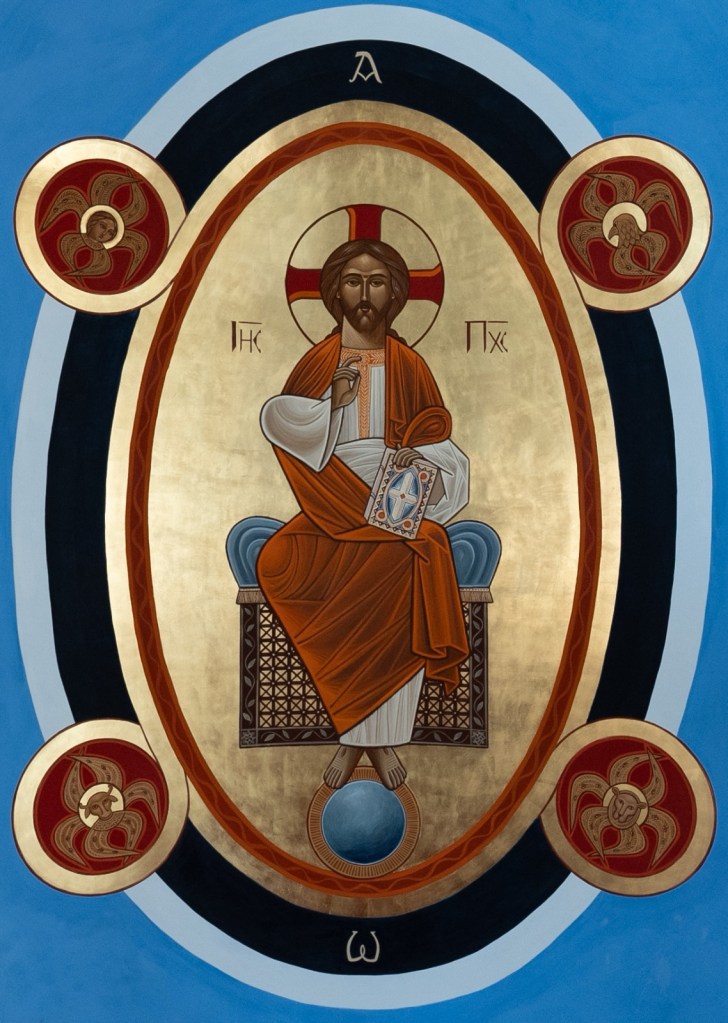
Christ Pantocrator, 6th Century, St Apollo’s monastery, Bawit, Egypt, now at the Coptic Museum, Cairo. This apse is one of the earliest depiction of Christ in Glory in the ellipse.
Christ in Glory or Pantocrator (Almighty), is arguably the most important icon to be found in a Coptic Orthodox church. It is always found in the central Eastern apse of the sanctuary. The image of Christ in Glory has remained more or less unchanged in content since at least the 6th century and possibly earlier. It depicts the vision described by St John the Divine in Revelations 5:5. Christ is enthroned inside an ellipse with Earth as His footstool, according to Isaiah 66:1 ” Heaven is my throne and earth is my footstool. He is surrounded by the Four Living Creatures. Below are the twenty four priests offering incense in perpetual praise.
Pantocrator 2019, St Mary & St Athanasius, Hillsborough NJ
The Pantocrator in the following video was designed according to the Neo-Coptic canon established by Prof Isaac Fanous and painted in the traditional egg tempera technique.
This film was edited by Daniel Corbett from spontaneous clips he recorded while working as my assistant. Four of us worked for 3 intense weeks during Great Lent in April 2019 at St Mary and St Athanasius Coptic Orthodox Church in Hillsborough, New Jersey.
The Making of a contemporary Coptic Pantocrator
Assisting me are Daniel Corbett, London, Calum Rees-Gildea, London, Amina Ahmed, New York























 Coptic Iconography